
Banner design
A retractable banner gives an indoor message its own display base. It can identify a booth, introduce a product, or welcome visitors without needing wall space. Its tall format also creates a design challenge: the information must work in a narrow column and remain visible in a busy room.
Use this retractable banner design guide to plan the layout before choosing images or writing long copy. The goal is a display that someone can understand while approaching, then read more closely if they are interested.
Give the banner one clear purpose
Choose whether the banner will identify your business, explain a specific offer, or guide people to an action. A trade show banner introducing a service needs different content from a store banner announcing a promotion.
Write the headline around that purpose. "Book a product demo" creates a clearer action than a paragraph about the company's history. You can provide details in a conversation, brochure, or landing page after the banner has attracted interest.
Browse retractable banners after identifying the display's job. The chosen product dimensions and template should guide the artwork, rather than forcing a finished square design into a vertical shape.
Plan a vertical reading order
Make the brand and main message visible near the upper part of the layout. Place supporting information underneath, with enough space to separate it from the headline. The next step should be easy to find when someone pauses to read.
| Layout area | Useful content | What to avoid |
|---|---|---|
| Upper section | Brand identity and main headline | A logo so large that the message disappears |
| Middle section | A product image or short benefit | Several competing images and long paragraphs |
| Lower visible section | A simple next step or short website address | Essential details hidden by furniture or the base |
On smaller screens, scroll the table sideways to read all columns.
This is a planning pattern, not a fixed print template. Follow the safe-area and finishing guidance for the selected display. The visible area can differ from the total artwork size.
Design for the room where it will stand
Think about the banner beside a table, in a store aisle, or near a registration desk. People and furniture may block its lower portion. Lighting and the background can also change how clearly the artwork appears.
Place the display within the permitted area and keep entrances and walkways clear. If several banners share a booth, give each a distinct purpose. Repeating a complete sales pitch on every surface can make the space feel busy without helping visitors find information.
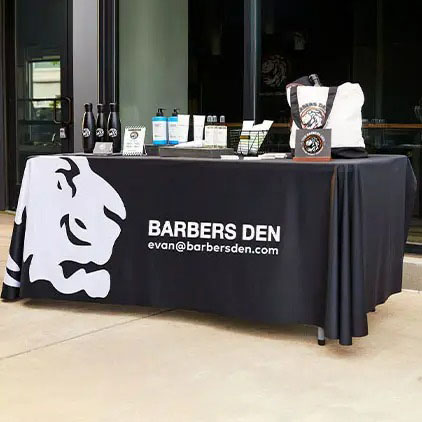
For a coordinated booth, custom tablecloths can carry the brand name at the front of the table. That lets the retractable banner focus on a benefit, demonstration, or event-specific message.
Keep typography and images simple
Choose clear lettering for the headline and supporting text. A narrow layout makes long lines awkward, so shorten the wording before reducing the type size. Keep line breaks intentional, especially within a product or business name.
Use one main image when it helps explain the message. A product photograph, service illustration, or simple graphic can work well if its original file has enough detail for the printed size. Avoid enlarging a small image from a website or social post.
Preserve logo proportions and keep text away from the edge areas identified in the template. Thin borders are difficult to align visually when artwork or mounting introduces small variations, so a border-free layout is often easier to adapt.
Make the action usable at close range
Give visitors a specific next step such as "Ask for a demo" or "Visit our website." Keep a short address readable. A QR code can be useful when the banner is close enough to scan and the destination offers something relevant.
Test the code with several phones from the likely scanning position. Confirm that it opens the intended page and has enough clear space around it. Include a readable alternative, since visitors may prefer to speak with staff or type the address later.
Prepare for setup and reuse
Check the assembly and care guidance for the selected base. Handle the retracting mechanism gently and store the display appropriately between events. The stand and material options should fit how often the banner will travel and how it will be used.
If the same display will appear at several events, consider an evergreen message. Place a changing date, discount, or event name on another item so the main banner can remain useful. Compare fabric banners when a hanging indoor display would better suit the venue.
Retractable banner design questions
Where should I put the most important information
Place it where approaching visitors can see it, usually in the upper part of the layout. Check actual sightlines and the product template rather than relying on a fixed height rule.
Can I put a QR code on a retractable banner
Yes, when people can stop near it and the printed code scans reliably. Explain the destination, give the code clear space, and include a readable alternative.
Are retractable banners a good option outdoors
Treat these displays as indoor options unless the selected product explicitly supports the intended outdoor conditions. A standing base and tall banner need a different evaluation from a securely mounted outdoor sheet.
Should I put my entire service list on the banner
Use only the information that supports its main purpose. A short benefit and clear next step are often more useful than a long list that visitors cannot read while approaching.